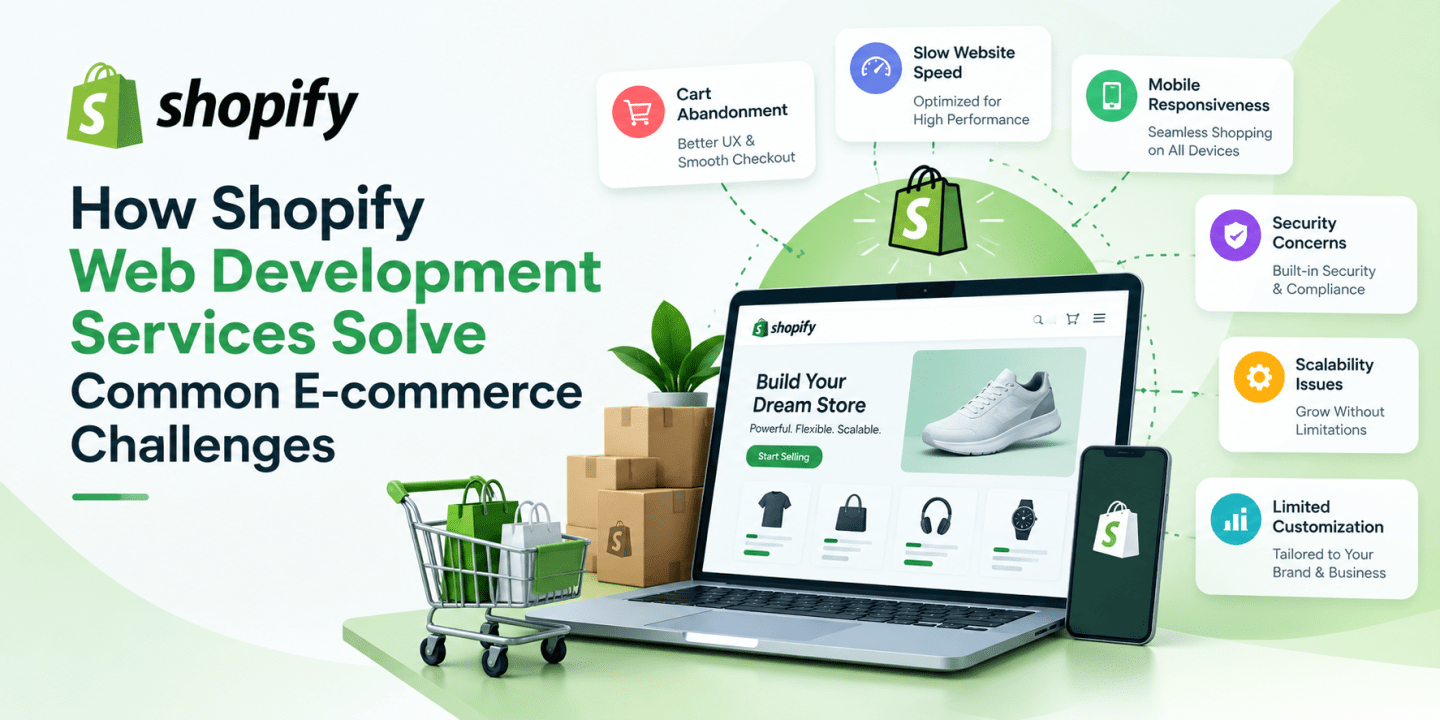
You hear the term online store and it sound simple until you get real people using your service. With good products, a nice brand and cash to play with marketing sales can still be lousy. People visit your site, look at products, add items to the cart, then leave before buying. Sometimes the main issue is that the pages load too slowly.
Sometimes customers cannot find important information. In other cases, the checkout process creates too much friction.
Many of these are everyday challenges e-commerce businesses encounter according to my research. Baymard Institute says the typical online cart is abandoned at about 70% in 2023. Some shoppers walk away when the total feels too steep. The share is 39%, and it comes up with added items such as shipping, tax, and other charges. The study also points to checkout problems. Around 18% leave because the process takes too long or feels hard to follow. This is where shopify web development company warm-ups.
The Problem: A Shopify Store Can Look Good and Still Lose Sales
I’ve noticed a lot of companies put most of their effort into product photos and sales ads. But they often do not pay attention to how the website actually feels to use.
That creates a serious problem.
Imagine a customer clicks your Google ad and reaches a product page. The page loads slowly. The product description does not answer the customer’s questions. Shipping shows up only when the customer gets to checkout. Also, the buyer has to make an account before the order can be finished.
At this point, you have already paid for the visitor, but the website may push that visitor away.
As per data available from Baymard’s long-running e-commerce checkout research, 70.22% represents the average documented online shopping cart abandonment rate across 50 different studies. Baymard also found that 19% of shoppers abandoned a purchase because they did not trust the website with their credit card information, while another 19% left because the site wanted them to create an account.
As I found over research, these numbers show that getting traffic is only half the job. Your website must also help that traffic convert.
The Agitation: More Traffic Cannot Fix a Broken Store
This is where so many e-commerce owners tend to go wrong, and it can be a costly mistake. Low sales—so they bolsters the ad spend immediately. They get a Google Ads management service, and begin to pour additional dollars into paid traffic. They might also do SEO, Content marketing or link building. However, more traffic does equal more lost opportunities if the store creates friction. So, when you have 1,000 potential customers landing on your website and your product pages do not address essential questions at all, then a lot of those potential customers will be lost before reaching checkout stage. This has to be the same experience with another 1,000 visitors coming in and going into it is still not a solution.
As per my experience, businesses should first ask a simple question: “Is my website ready to convert the traffic I am already getting?”
This question can save money.
In 2024, WordStream looked at more than 17,000 search ads from the US. Their report said the average conversion rate on Google Ads was 6.96%. They also reported a mean cost per click of $4.66. For cost per lead, the average came to $66.69. While these numbers are not indicative of every Shopify store, they illustrate the point about conversion performance. But the point of a pay-per-click model and its skin is to convert as many qualified visitors into customers on your site.
The Solution: Shopify Web Development Services
A professional Shopify web development company does more than change colors or install a new theme.
Good development starts with the customer journey.
A developer watches how people get into the store. They note what paths visitors take. They also track how shoppers look up items. Next, they pay attention to how people compare products. After that, they watch what happens when buyers add things to a cart. Finally, they observe how shoppers finish the payment.
The goal is to remove unnecessary friction.
A Shopify developer can improve navigation, product pages, mobile usability, collection pages, checkout-related elements, site speed, product filters, search functions, payment integrations, and third-party applications.
As per my research, this type of work can have a direct connection with conversion performance. Baymard’s research estimates that the average large e-commerce site could increase its conversion rate by 35.26% through checkout design improvements alone. Baymard came to this number after a long round of usability tests. They looked closely at checkout screens from big online stores.
I would not tell every Shopify store owner that they will get a 35% increase. That would be an irresponsible promise. The useful lesson is that checkout design can have a measurable effect on sales.
A Real Research Case Study Shows Where the Problem Starts
One reason I like Baymard’s research is that it does not simply look at website traffic. It studies how real users interact with e-commerce checkout systems.
Baymard’s research involved more than 11,000 participants across quantitative studies, along with usability testing and analysis of hundreds of checkout steps. Its researchers identified thousands of usability issues during their work.
One finding stands out to me.
Baymard found that an ideal checkout could use as few as 12 form elements, while its benchmark showed an average of 23.48 form elements displayed by default in US checkout flows.
This gives Shopify store owners a practical lesson.
Customers do not want unnecessary work.
They want to know what they are buying, what it costs, when it will arrive, and how they can pay. A Shopify web development company can help structure the store around those needs.
SEO and Shopify Need to Work Together
Website development alone does not guarantee organic traffic.
The store also needs a strong SEO strategy.
And this is where white label SEO services come into play for agencies that create Shopify stores for clients. Rather than employing a complete SEO group in-house, an agency can associate with a specialist partner and carry out SEO under its own personal logo. On the other hand, SEO handles keyword research, content planning, on-page optimization (schema markup), technical SEO tips and guides to build internal links report. In my experience, this model works best for agencies that already provide web development and have yet to develop significant internal SEO resources.
However, agencies should focus on useful content instead of producing hundreds of pages only to target keywords. Google currently warns against scaled content abuse, which includes creating large amounts of low-value content mainly to manipulate search rankings.
That means Shopify stores should create content for customers first and search engines second.
Where Google Ads and SEO Can Work Together
A Shopify store can use both paid and organic traffic, but each channel has a different role.
A Google Ads management company can help a store reach people who already search for products or solutions. SEO can help the store build organic visibility over time.
I see this as a useful combination.
Paid ads can provide immediate testing opportunities. If a product page receives clicks but few purchases, the business can investigate the page experience, offer, pricing, trust signals, or checkout process.
SEO can then build longer-term visibility around relevant searches.
The important thing is to connect both channels to the same conversion goals.
What About Adult Link Building for Shopify Stores?
Some agencies also work with adult e-commerce businesses, where standard outreach and publishing options can become more limited.
Adult Link Building can support an SEO strategy when agencies use relevant websites, appropriate content, and legitimate publishing relationships.
But I would avoid buying large numbers of unrelated or low-quality links just to increase backlink numbers.
Google’s spam policies make it clear that practices designed to manipulate search rankings can create problems for websites.
As per my research, relevance matters more than simply chasing a large backlink count. For an adult Shopify business, the SEO strategy should also respect the policies of search engines, publishers, payment providers, and advertising platforms.
The Future of Shopify Development Is About Conversion
The future of e-commerce development will not focus only on making websites look better.
It will focus on helping websites perform better.
In my experience, Shopify store owners should focus on the full path a buyer takes. Someone lands on the site, then they should reach a product page, then the cart, and finally checkout. There should not be any guesswork.
This takes more than one role. Developers have to be on the same page. SEO work matters. Content writers should keep things clear. Paid ads teams need to match what people see on the site.
A Shopify web development company can build the foundation. White label SEO services can help agencies expand their SEO offering. A Google Ads management company can help bring qualified paid traffic. Adult Link Building can support specialized SEO campaigns for suitable businesses.
But all of these services should work toward one goal: helping the customer make a confident buying decision.
As I found over research, the biggest opportunity may not always come from getting more visitors. Sometimes it comes from fixing the experience for the visitors you already have.
This is why Shopify web work should not be treated like a single setup job. It needs to run on a cycle, with checks, updates, and lessons built in.
Once you cut the delays, spell out key details, and smooth out the checkout step, people are more likely to stay. You also get your marketing efforts to match what the store shows. Then the visitor has a clearer path to buying.
To me, that is the real point of good Shopify development.
About Author